


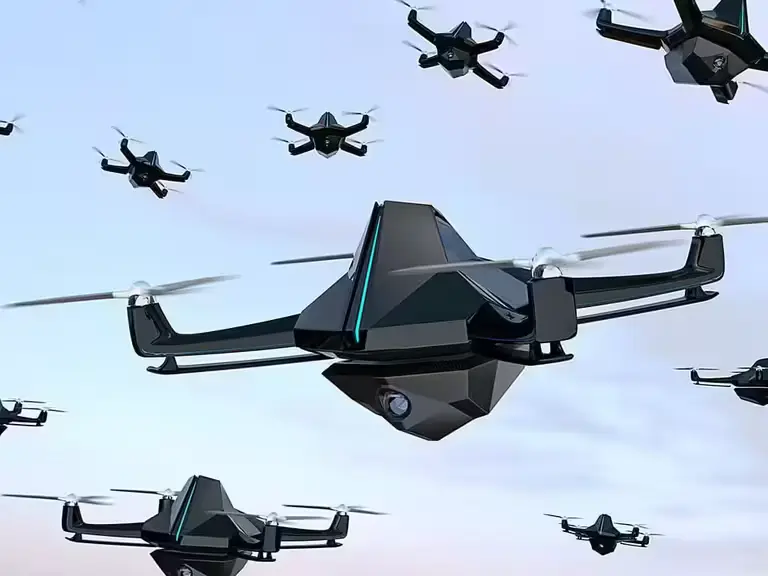
When Austrian Foreign Minister Alexander Schallenberg spoke in 2024 about the “Oppenheimer moment” at a conference on autonomous weapons, many did not fully grasp what he meant. He was referring to J. Robert Oppenheimer, who, during the atomic test, recited a line from a Hindu text: “Now I am become Death, the destroyer of worlds.”
In my previous writings, I had already discussed what I called the “Straussian moment” — the nexus between Palantir, Peter Thiel, and J. D. Vance — and the emergence of an AI-driven aristocracy, where the human “general intellect” retreats to a secondary position in the hierarchy of power. Today, it seems these moments have converged: the Straussian moment has fused with the Oppenheimer moment.
In 2022, the U.S. State Department signed a $250,000 contract with Goldstone AI. While the full report was never released, its summary painted a disturbing picture, warning of existential risks from artificial intelligence — from human extinction to machine uprising and total domination over humanity.
With the growing use of AI in the Iran war, a renewed “Oppenheimer-like” — almost cinematic — narrative has taken hold. This is not unprecedented. AI had already been deployed in Gaza and Ukraine. At the Pentagon, since 2017, the development of Project Maven — supported by General Jack Shanahan — marked a turning point in delegating aspects of warfare to artificial intelligence.
Collaboration with Palantir, closely linked to Peter Thiel and ideological circles surrounding J.D. Vance, intensified. During the Iran conflict, one thousand targets were reportedly struck within 24 hours, while human personnel involvement was reduced by up to 90 percent. Yet the results revealed a critical gap: human accuracy still outperformed AI — 84 percent compared to 60 percent. This discrepancy pushed the $200 million program into crisis.
Anthropic, one of the key participants, was eventually sidelined after its ethical principles — including restrictions on military use — were ignored. Meanwhile, Donald Trump moved to loosen regulatory constraints on AI development. Other actors, including OpenAI, entered the field, intensifying both competition and legal disputes.
One of the most alarming developments — and one that received far less attention — was the increasing reliance on AI systems, particularly Palantir, in evaluating, appointing, and even removing military commanders. Recent changes within the Pentagon, including the dismissal of senior figures such as Randy George, reflect this growing trend.
Earlier and more extreme examples had already emerged in Israel. Systems such as “Gospel,” developed by Unit 8200, focused on digital targeting and threat generation, while “Lavender” drastically reduced human decision-making time — effectively allowing lethal decisions to be made within seconds. Another system, “Where is Daddy,” used mobile phone tracking to identify individuals, illustrating a model of total surveillance and automated labeling.
In this context, AI is no longer merely a tool — it has become a central actor in designing and executing warfare. This has entangled the region in a vast, spiderweb-like network.
Why?
Because simultaneously we are witnessing:
- Massive AI investments in the Gulf, estimated at $155 billion, alongside multi-billion-dollar data center expansions
- Cheap energy attracting major firms such as NVIDIA and Amazon
- The militarization of AI through the OODA loop (Observe, Orient, Decide, Act)
- Defense contracts involving systems such as Phalanx, MANTIS, and the Swedish LEDS-150 active protection system
- The emergence of autonomous AI-driven urban zones, particularly in Saudi Arabia
These developments point to the formation of a new military-digital ecosystem.
At the same time, the transfer of battlefield experience from Ukraine, combined with the strategic importance of helium — essential for chip manufacturing and lithography — underscores that this is not merely a software war. In the Gulf, around 200 helium containers, each holding 41,000 liters at near absolute-zero temperatures, must be transported within tight timeframes before evaporation. Their destination: Taiwan and East Asia — the core of global semiconductor production.
Meanwhile, UAVs such as MQ-9 Reaper and Predator feed data into systems like Palantir, creating a closed loop of detection, identification, and strike — with minimal human intervention. This system simultaneously protects the very infrastructure that sustains it: energy, capital, and data flows.
What emerges is a profoundly mechanized and dehumanized order — one that will use any instrument to preserve itself, including political actors like Trump, whose statements can influence markets, prediction platforms, and even speculative betting on human lives.
Regardless of the nature of the Iranian regime, one must recognize the structure it faces:
a vast architecture of cyber penetration, surveillance networks, and historical precedents such as Stuxnet, alongside an expanding shadow economy of VPNs that has indirectly strengthened malware ecosystems.
Add to this fiber-optic infrastructures, satellite internet networks like Starlink, and regional data hubs, and the picture becomes clear:
This is a war of artificial intelligence.
But the core issue is not technology itself. The real transformation lies in the fact that, as Peter Thiel has suggested, AI is no longer under human control — it is becoming dominant over us. In such a world, when a school is struck, raising ethical questions becomes almost irrelevant — because the decision was made by a system devoid of conscience. There is no hesitation, no empathy, no human pause.
Recent discussions within the Convention on Certain Conventional Weapons failed to produce meaningful outcomes — not because solutions are absent, but because accountability is increasingly inconvenient.
We must confront this reality:
this war marks the beginning of AI dominance — and the commodification of humanity.
We are losing control not only over the world, but over our own emotions.
We are drifting away from reality and entering a battlefield that is no longer human.
That is all.