


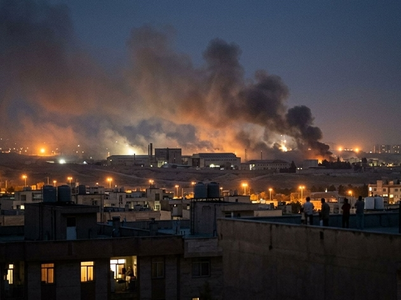
When Jean Baudrillard famously declared that the Gulf War did not take place, I did not understand what he meant.
In Simulacra and Simulation, Baudrillard describes a new regime of reality shaped by media and representation. Simulacra are signs that have lost their original reference; representations that continue to exist without a real object behind them. They belong to what he calls hyperreality —a world in which representation not only imitates reality but often replaces it.
At the time, I could not fully grasp his point. The Persian Gulf, for many observers, was simply “the East”—a landscape imagined through the exotic fantasies of One Thousand and One Nights. Within this Orientalist frame, the catastrophe of Iraq, the deaths of hundreds of thousands, years of internal conflict and humanitarian crisis rarely occupied the moral centre of Western attention.
Even Saddam Hussein’s crimes against his own people —against Shiites, Kurds, and Sunnis alike— or his reckless wars with neighbouring countries were not the decisive issue. The moment of true concern came only when that madness became uncontrollable, and the collapse went beyond a political regime to the disintegration of an entire national identity: Iraq itself.
Something similar later unfolded in Libya. Afghanistan experienced it. Yemen is living through it today. And Iran, under the shadow of a second Khamenei, now watches the possibility of such a fate approaching.
In my mind, this situation often recalls another moment in history: when Francisco Franco invited Nazi forces to bomb the Spanish town of Guernica. A dictatorship that collaborated with Germany to destroy a city. Years later, when Pablo Picasso painted Guernica, he refused to allow the painting to return to Spain as long as Franco remained in power. According to a well-known story, when a German officer asked Picasso, “Did you create this painting?” he replied: “No—you did.”
But beyond these historical examples lies the deeper problem of our present moment.
The killings of January protests, the waves of repression, the twelve-day war, the assault on Iran by Netanyahu and Trump under the pretext of “help,” and the suffocating political deadlock that surrounds it all have exposed a painful truth: the absence of a nation capable of narrating its own story.
A people that cannot produce its own narrative becomes the subject of stories written by others.
Its voice is silenced. Even in the midst of destruction, others speak on its behalf. The same actors who imposed war now dominate the screens of global media. In pursuit of ratings and spectacle, they trample over the body of a country called Iran. Netanyahu, Trump, and their radical ideological allies —each in their own way— stand over that body, tearing it apart like scavengers.
Look at the global production of commentary and content. Where exactly is Iran in these narratives?
Others construct the story. Others interpret the collapse. With the same gaze that once imagined “the East,” they built the final walls of that imagined world —and now sell its destruction to us with a mixture of fascination and theatrical regret.
Meanwhile, a society already fractured from within is crushed under shallow analysis and geopolitical spectacle.
This is the larger picture: the choreography of war, the machinery of repression, the profits of arms manufacturers, television networks chasing ratings, and the so-called Iran experts who colonize even the language through which a nation might speak about itself.
The endless repetition of breaking news —without even a moment of pause— has normalized catastrophe. Images circulate continuously. Disaster becomes routine.
Nothing seems extraordinary anymore.
We have seen worse.
Hollywood’s endless imagery has trained us well. Like the forced spectators in Kubrick’s “A Clockwork Orange”, we sit before the screen as violence unfolds, polished and stylized, a Joker-like smile emerging from the very blood it produces.
I am tired.
Tired of analysis. Tired of waking up and checking my phone five hundred times. Tired of calling my mother to make sure she is still alive. Tired of following the news of friends who have died.
Living in such a world is exhausting.
And saying this sentence is difficult: I oppose the regime, yet I cannot accept the destruction of my country —especially at the hands of those who show no mercy. Blood cannot cleanse blood.
Sometimes I imagine a different arena altogether: a modern Colosseum where those who desire war could enter the arena like gladiators and fight each other to the death.
I know the reader may have expected a purely analytical essay. Perhaps I have disappointed you. But sometimes reality is heavier than analysis.
War has no real logic. War is about domination, not liberation. Historical analogies offer no prescription for Iran.
For forty-seven years, Iranian society has endured relentless pressure, economic plunder, humiliation, and fragmentation. Every day, official narratives repeat that the nation is united. But beneath the surface, the fractures run deep.
Perhaps the only thing capable of producing a fleeting sense of unity is war itself: the death of loved ones, the tremor that shakes the pillars of homes.
Otherwise, ideological actors —whether Muslim, Christian, or Jewish— pursue entirely different agendas.
Generational divides, economic collapse, psychological trauma, and political fragmentation already tear society apart. Add the grinding gears of sanctions and war profiteers, and the result is a social body slowly dismembered.
If the devastation of war is added to this fragile reality, Iran may cease to exist as the country we once knew.
Infrastructure will collapse. A weakened regime may retreat inward toward Tehran. Oil will be plundered. Poverty and unemployment will spread. The minds of war-traumatized children will be shattered —just as my own childhood mind was scarred by bombings during the Iran-Iraq War.
Cities will bleed: Tehran under smoke, Tabriz wounded, Urmia, Saqqez, and Ahvaz broken. The Shah Mosque in Isfahan, the Bam Citadel, the Soltaniyeh Dome in Zanjan —centuries of history could fall into dust.
And Iran would join the tragic geography of our time: Syria, Iraq, Gaza, Afghanistan.
For the architects of war, it makes no difference who you are. Whether you wear the symbols of piety or the marks of rebellion. Even the anklets of a Baluch woman become spoils.
Years of disorder would follow. Like Nero setting Rome ablaze.
Today, all roads lead not to Rome —but to war.
We are already living inside a war. A war that, paradoxically, has not officially happened.
We live in a hyperreality —between the exclusive analyses of distant observers and the blind certainties of extremists who refuse to see anything at all.
We are trapped between dark faiths.
Forgive the ignorance of those who feed on war. We did not create this war, yet war has reshaped us.
This is all I could write.
I am not well. I feel ashamed that one day I might return home and stand before the door of my childhood house —like Edward Said— and find myself unable to face it.
Take care of your country.
We were not there.