


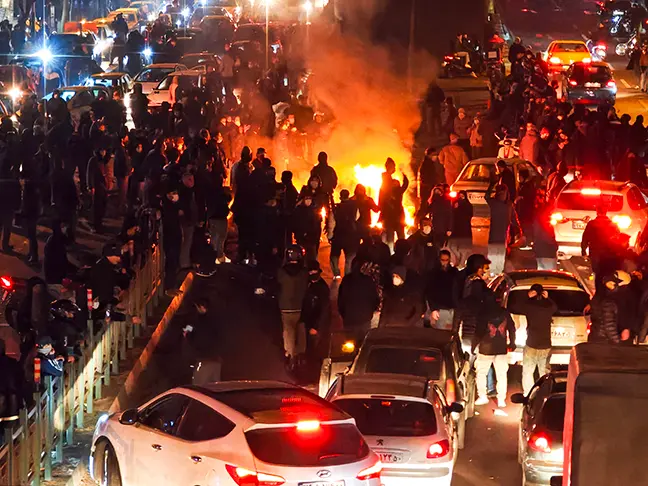
Iran has been gripped for more than ten days by a wave of street protests that began in Tehran’s Grand Bazaar and gradually spread to smaller and peripheral towns. These protests have unfolded amid a deep economic crisis, sweeping sanctions, and rising external tensions, making the position of the Islamic Republic more fragile than at any time in recent years and refocusing international attention on Tehran.
After Venezuela, all eyes turned to Iran. Instead of Colombia, Mexico, Panama, or even Cuba dominating the headlines, Iran moved to the center of global attention. A country that has been experiencing sustained street protests for over ten days—protests widely described as rooted in severe economic pressure and initially sparked in Tehran’s main market. Yet these protests are not merely economic in nature. They have multiple dimensions, unfolding as the risk of another Israeli strike hangs over Iran—or more precisely, the Islamic Republic—like a sword of Damocles.
The protests are taking place as Iran’s economy has effectively reached the brink of collapse. According to domestic official and semi-official estimates, the poverty line has fallen below $200 per month, with nearly 70 percent of the population living beneath it. Unemployment is estimated at around 40 percent, while inflation hovers near 70 percent. The budget deficit is also estimated at close to 40 percent, underscoring the government’s acute lack of resources.
Iran remains under heavy sanctions, and intermediary exchange networks used to bypass those sanctions have reportedly failed to return billions of dollars to the domestic economy. In an attempt to ease pressure, the government has melted down and released 76 tons of gold into the market. Banks are either effectively bankrupt or have absorbed state resources without returning them. At the same time, the high costs of Iran’s nuclear program, missile capabilities, proxy networks, and its military and political presence in Syria, Lebanon, and Iraq have placed an additional burden on an economy that is already in a state of near coma.
Against this backdrop, a corrupt, dysfunctional, unplanned, and rent-seeking governance structure has further eroded living standards. As a result, alongside long-standing demands for political freedoms, an end to discrimination, and the cessation of repression, economic grievances became more pronounced. This time, even Tehran’s bazaar—traditionally seen as a pillar of economic stability—entered the protest movement.
In the early stages, the government sought to manage the protests by narrowing their scope and reframing them purely as economic discontent. That effort failed. The protests rapidly spread to smaller towns—or, more accurately, their initial sparks had already emerged from marginalized and impoverished areas. According to studies by Iran’s parliamentary research center in the spring of 2025, these regions ranked highest in indicators of misery, poverty, and unemployment.
Repression in such areas was easier due to their distance from the capital and their limited presence in national and international media coverage. Nevertheless, Tehran’s attempt to label the protests as “riots” and strip them of their legitimate social demands did not succeed. The movement moved beyond economic grievances, and in some regions—particularly in Ilam province and its surrounding towns—it escalated into intense clashes. According to available figures, at least 36 people have been killed and roughly 1,000 detained, numbers that have themselves contributed to further escalation.
As a result, the protests increasingly came to symbolize the demand for regime change. While authorities attempted to monopolize the narrative and attribute the unrest to specific opposition groups in order to prevent broader mobilization, areas that had previously remained relatively quiet eventually joined the wave. Even though the protests were largely entropic and anomic—reflecting deep social fractures—they nonetheless pushed the state into a position of visible paralysis.
The government responded by reshuffling budget allocations and announcing a seven-dollar food voucher for each citizen. Rather than offering relief, the measure was widely perceived as an insult to public dignity and a sign of economic deadlock. This came at a time when the exchange rate had already surged, fuel prices had risen, and society—having just emerged from a twelve-day war—was psychologically strained and near a breaking point.
On the external front, messages from Donald Trump following the arrest of Nicolás Maduro—addressing disruptions to Hezbollah-linked networks in South America and oil-related issues—combined with the silence of China and Russia, further complicated Tehran’s calculations. A central question emerged: could these protests lead to regime change in the long run, or were the signals aimed at segments of Iran’s technocratic elite opposed to Ali Khamenei, encouraging them to exploit the moment to alter the power structure?
Tehran, however, showed no sign of retreat. Statements by Ali Khamenei made clear that the repression apparatus would remain active. Protesters were labeled “rioters” and, in some cases, “foreign agents,” effectively granting religious and political legitimacy to continued crackdowns. At the same time, Trump’s comments about possible military intervention prompted a response from Iran’s Supreme Defense Council, which raised the prospect of a preemptive strike against Israel, a U.S. ally. The result was heightened tension rather than de-escalation.
Following Israel’s twelve-day campaign against Iran, Tel Aviv had anticipated that domestic unrest would lead to Tehran’s collapse—an expectation that did not materialize. This time, however, with Israeli elections approaching and protests underway, speculation about an earlier strike has resurfaced. Whether Washington and Tel Aviv fully align on such a course remains unclear. It is also uncertain whether a military attack would facilitate a “soft transition” in Iran or instead push an already fragmented society toward internal conflict.
Meanwhile, some groups continue to advocate for external military intervention, viewing it as a pathway to political transition. Yet this perspective remains contested, both in light of regional precedents and the strategic interests of external actors.
Conclusion
Iran today faces a convergence of deep economic crisis, widespread social unrest, and mounting external threats. The governing structure has shown neither the capacity for internal reform nor the ability to ease external tensions. The central question is no longer whether the crisis will deepen, but whether the state can manage these overlapping pressures—or whether the country is heading toward a far costlier phase of instability.