


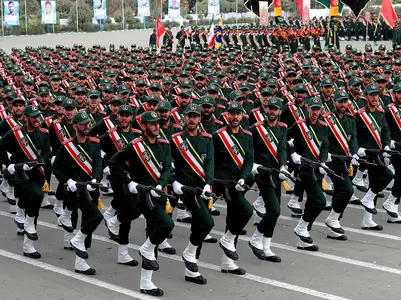
When Iran’s military budget is discussed, the figure most often cited is around 10 billion dollars. It appears repeatedly in international reports and has gradually become a reference point in public debates. Yet this number reflects only a limited part of reality. A closer look shows a wide gap between international estimates, Iran’s official budget figures, and the extensive economic and security network controlled by the Islamic Revolutionary Guard Corps. This gap translates into tens of billions of dollars in hidden costs that weigh on Iran’s economy every year.
The 10 Billion Dollar Illusion
The first step is to separate two different concepts that are often treated as one. On the one hand, there are international estimates of Iran’s military spending. On the other hand, there are the military allocations written into Iran’s state budget. The widely cited 10-billion-dollar figure comes from institutions such as the Stockholm International Peace Research Institute and the World Bank. It is an external estimate of observable military expenses, including weapons procurement, operations, and defense-related spending. It is not a simple total of the budget lines approved by the Iranian state.
Inside Iran’s annual budget, military resources are distributed through multiple fragmented lines, different exchange rates, special clauses, and off-budget allocations. When these are converted using the official budget exchange rate, total declared military spending can exceed 15 billion dollars, and in some calculations, reaches close to 20 billion dollars. The difference does not necessarily indicate faulty data. It reflects different accounting methods and different levels of transparency.
The IRGC’s Formal Share
Within this structure, the Islamic Revolutionary Guard Corps receives a particularly large share. When direct allocations, indirect funding, and affiliated bodies such as the Quds Force, the Basij, and related foundations are combined, the IRGC’s official budget in recent years is estimated at roughly 300 trillion tomans, or about 5 to 6 billion dollars at the official rate. Even on its own, this represents a significant portion of Iran’s declared military spending. Yet it still captures only the formal and visible side of the IRGC’s power.
Neither the 10-billion-dollar international estimate nor the 5-to-6-billion-dollar official IRGC budget provides a complete picture. The first reflects how Iran’s military spending looks from the outside. The second reflects what the state formally approves. Beyond both lies a far larger sphere of economic activity does not appear in public budget documents at all.
The IRGC as an Economic Actor
When analysts speak of the IRGC’s role in Iran’s economy, they are not referring to its military budget. They are referring to the scale of economic activity the IRGC directly or indirectly controls. This control operates through company ownership, privileged access to major contracts, management of key infrastructure, and decisive influence over how resources are allocated.
Research-based estimates suggest that the IRGC oversees 30 to 50 billion dollars in effective annual economic turnover. This does not mean net profit. It describes the volume of economic activity that, in practice, cannot move forward without the approval or involvement of IRGC-linked networks. Energy, oil and gas, petrochemicals, construction, ports, telecommunications, and national infrastructure projects sit at the center of this influence.
A Sharp Contrast with the Regular Army
This economic reach stands in stark contrast to the position of Iran’s regular army. The army remains almost entirely dependent on state funding and is deliberately kept out of large-scale economic activity. It has no comparable web of holding companies, contracting giants, or financial intermediaries. The limited economic entities associated with the army, such as housing or welfare cooperatives, serve internal needs and have no meaningful impact on the wider economy. As a result, the IRGC has evolved into a military institution with economic power, while the army has remained a professional force tied strictly to the state budget.
The Grey Economy
A significant part of the IRGC’s influence flows from the grey and informal economy. This includes sanctions evasion, unofficial energy exports, border trade, and offshore financial networks. The regular army has no role in these activities. The result is not only a numerical gap between the two forces but a structural imbalance that shapes Iran’s political economy.
The Cost of Proxy Power
Another layer of the picture is Iran’s regional proxy strategy. When references are made to the budgets of so-called resistance or proxy forces, this does not involve officially approved state spending. These costs are largely channeled through the IRGC’s Quds Force and cover financial, military, logistical, and operational support for allied groups across the region.
Independent assessments place Iran’s annual proxy spending between 6 and 12 billion dollars. Hezbollah in Lebanon alone is estimated to receive 700 million to 1 billion dollars each year. Armed groups in Iraq account for 1 to 2 billion dollars, Yemen for 300 to 500 million dollars, and Syria and Palestinian factions for an additional 1 to 2 billion dollars combined. Smaller networks, including groups such as Zaynabiyoun, Husayniyun, and affiliated structures in parts of Africa, operate at lower but flexible costs. Together, this lower-cost proxy layer is estimated at 300 to 600 million dollars annually. None of these expenditures involves the regular army. They form part of the IRGC’s external security apparatus.
Corruption as a Built-In Cost
The concentration of military, economic, and security power within a single institution has also produced systemic corruption. Estimates suggest that corruption linked to the IRGC costs Iran’s economy 15 to 25 billion dollars each year. This does not mainly consist of easily traceable embezzlement. It takes the form of resource waste, inflated contracts, rent-seeking, organized smuggling, and structural tax avoidance.
Much of this damage stems from monopoly contracting. Projects awarded without real competition often come with cost overruns of 30 to 50 percent. Additional losses arise from the grey economy and evasion of sanctions. While these practices may generate short-term cash, they impose long-term economic harm. Such patterns are neither visible in the army nor compatible with its strictly budget-bound role.
Conclusion
What is commonly described as Iran’s military budget is only the surface of a much deeper structure. Beneath it lie two profoundly unequal military institutions. One, the IRGC, has transformed itself into a central political and economic actor. The other, the regular army, remains a professional force confined to state appropriations. The core issue is not a few extra billion dollars one way or another. It is the militarization of the economy through a single institution and the long-term cost this imbalance imposes on Iranian society.