


Merve Firat, PhD Candidate at SciencesPo Paris and METU
Riccardo Gasco, PhD Candidate at Bologna University
من لە وڵاتی بێ وڵاتدا لەدایک بووم
Min le welatî bê welat-da le dayik bûm.
I was born in a country without country.
— Şêrko Bêkes
For much of the modern history of the Middle East, Kurds have negotiated their political existence within borders they did not draw. In Syria, this produced decades of statelessness, exclusion and restrictions on Kurdish identity. The civil war reversed that position, moving Syrian Kurds from the margins of the state to the center of the order that emerged from Syria’s fragmentation.
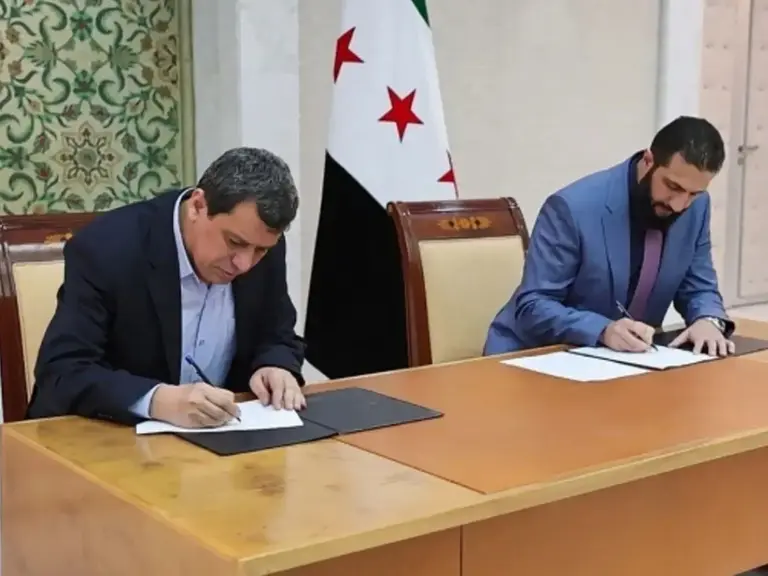
That position has now been reversed again. The rise of the Kurdish-led Syrian Democratic Forces (SDF) had also made it one of the thorniest problems in Turkey’s relationship with the United States. Washington built its counter-ISIS campaign around a force Ankara regarded as the Syrian extension of the PKK, and for a decade the two allies managed that contradiction without resolving it. With Assad gone and a new order consolidating in Damascus, the structure that carried those gains has been dismantled outright. On 25 August 2026, standing in the presidential palace in Damascus, Mazloum Abdi declared the end of the SDF’s mission and its dissolution as an independent military force, following the completion of the integration of its units into Syrian army brigades.
For Ankara, a unified Syrian state resolves what it has long treated as its principal security threat: an autonomous armed structure dominated by the YPG along its southern border. Dismantling that structure and folding it into the Syrian state has been Turkey’s first objective in Syria since Assad’s fall, and it has now been met. What remains open is the second question Ankara has never clearly separated from the first. Kurdish military autonomy and Kurdish political autonomy are not the same thing, and now that the first has been eliminated, the treatment of the second will determine whether the settlement delivers the stability and territorial unity Turkey seeks to promote.
From Statelessness to De Facto Autonomy
The borders drawn after the First World War divided Kurdish-inhabited regions across several states. During the French Mandate, Syria became an important center of Kurdish political and cultural activity, with refugees, intellectuals and activists settling particularly in the Jazira region. Among them, exiled Ottoman officers and nationalist intellectuals founded Xoybûn in Lebanon in 1927, a transnational league that coordinated Kurdish activity across the new borders and organized the Ararat revolt against the Turkish republic. Syria under the Mandate thus became a base for Kurdish politics directed at Turkey as much as a home for Kurdish communities within Syria.
Independence closed that space. Successive governments read Kurdish identity through the lens of Arab nationalism and state security. The 1962 extraordinary census in al-Hasakah stripped tens of thousands of Kurds of citizenship, creating categories of stateless Kurds whose descendants lived for decades with restricted rights, while Arabization policies, above all the Arab Belt project, transformed Kurdish-majority areas along the Turkish border.
The 2011 uprising broke this arrangement. As the regime redeployed forces from the north in 2012 to defend the center, Kurdish political and military actors took control of much of the north and northeast. Wartime necessity became a broader experiment in self-government through local councils, security institutions and eventually the Autonomous Administration of North and East Syria. The campaign against ISIS completed the transformation, making the SDF Washington’s principal local partner and giving the Kurdish-led administration leverage and international visibility Syrian Kurds had never possessed.
That partnership was always narrower than it looked from Qamishli. Washington defined it by a single mission, and when the mission ended the rationale ended with it. American officials declared that the original purpose of the anti-ISIS partnership had largely expired and backed integration into the new Syrian military. Forces left the al-Tanf garrison in February 2026, and the handover of the Qasrak air base ended a decade of continuous American ground presence in April. The protection that had underwritten Kurdish autonomy was withdrawn before the settlement meant to replace it had been tested. For Ankara this removed the largest irritant in the bilateral relationship. For Syrian Kurds it removed the guarantor.
The question today is therefore not whether SDF units come under Syrian state authority. It is whether more than a decade of political, administrative and security gains survives that transfer.
Integration Without Surrender?
The March 2025 agreement between transitional president Ahmed al-Sharaa and SDF commander Mazloum Abdi was meant to answer this. It envisaged integrating northeastern Syria’s civil and military institutions into the state, affirmed territorial unity and recognized Kurds as an integral part of the country. It failed. Implementation stalled, the talks ran past the provision for completion by the end of 2025, and violence unfolded in Aleppo.
What followed settled the question by force. Concluding that the balance of power had shifted decisively, Damascus reframed integration as an urgent imposition of territorial sovereignty, triggering a breakpoint in early January 2026. A fourteen-point American-brokered deal halted the fighting, ceded Raqqa and Deir ez-Zor unconditionally and shelved the March framework. The agreement signed on 29 January provides for the individual vetting of SDF fighters before their absorption into the defense and interior ministries, alongside the regulation of border crossings, oil and gas fields and local security arrangements. Implementation advanced quickly across Hasakah, Qamishli and Ain al-Arab through the spring and summer, and closed on 25 August with Abdi’s dissolution announcement.
Damascus and Washington frame this as a step toward national unity. Kurdish actors and protesters have characterized it as coerced surrender carrying the risk of renewed repression.
Both readings capture something real, and the distance between them is the distance between integration and dissolution. Presidential Decree No. 13 granted citizenship to thousands of previously disenfranchised Kurdish residents, recognized Kurdish as a national language taught in regional schools and designated Nowruz an official holiday. The dissolution package added positions in the Syrian government for Abdi and for Ilham Ahmed, who headed the Kurdish-led administration. These are not trivial concessions. They are the substance that survived the collapse of Kurdish military leverage, and they now carry the entire weight of the settlement.
The question is therefore whether rights conceded on paper are honored now that the armed structure which extracted them no longer exists.
The View from the Ground
Kurdish attitudes cannot be reduced to the positions of the SDF or the Democratic Union Party. Kurdish politics in Syria has always contained ideological, partisan and regional divisions. Yet three overlapping experiences make demands for guarantees difficult to dismiss as attempts to preserve wartime privilege.
The first is the memory of Damascus, where decades of discrimination and restriction produced deep skepticism toward an unconstrained central state. The second is Turkey. The operations in Afrin in 2018 and between Tal Abyad and Ras al-Ayn in 2019 altered the geography of Kurdish-controlled Syria, and displacement and the conduct of some Turkey-backed armed groups reinforced the perception that local security institutions were safeguards against renewed vulnerability rather than political assets. The third is the character of the emerging state, and whether institutions produced by Syria’s transition can protect minorities, accommodate pluralism and prevent sectarian violence.
This is why disarmament cannot be separated from political trust. Abdi’s passage from military command to a post within the Syrian state is the test case. Whether Kurdish demands can be pursued through political institutions rather than defended by force determines whether January produced a settlement or a postponement.
Ankara’s Syrian Endgame
Turkey has achieved what it sought. Damascus is friendly, the YPG structure has been dissolved, and Turkish involvement in building the new Syrian army has converted a temporary intervention into an institutional partnership.
The domestic dimension is inseparable from this, though the two files have never moved at the same pace. On 10 August 2026 the Turkish parliament passed a law establishing a legal framework for the disbandment of the PKK, protecting former militants not implicated in specific crimes and suspending sentences for many convicted of membership. It carried 467 votes, uniting the AKP, the MHP and the pro-Kurdish DEM Party. The amnesty is limited and excludes Öcalan, whose release remains a central demand of the DEM Party and of the wider Kurdish movement.
The sequencing is the point. Ankara moved to close the Syrian file first, treating the dissolution of the YPG structure as achievable through Damascus and Washington while the domestic process advanced slowly through commissions and drafts. The two questions share a common origin, and Öcalan’s February 2025 call addressed a movement that spans both, but Turkey has handled them through different instruments and on different timetables. The resulting asymmetry is stark. In Syria, disarmament arrived under military pressure and was completed within seven months, while the political settlement remains a decree awaiting implementation. In Turkey, the legal architecture came first. Ankara has an interest in the Syrian sequence not discrediting the Turkish one, because the same constituency is watching both.
Iran is the second complication. PJAK has refused to dissolve or lay down its weapons despite recognizing Öcalan as its intellectual leader, exposing the limit of an endgame defined by the dismantling of organizations rather than the settlement of grievances. The Iran war made this concrete. In early March 2026, as American and Israeli strikes entered their second week, Trump publicly urged Iranian Kurdish opposition groups to rise against Tehran, saying he would be entirely in favour of a Kurdish ground offensive and calling Kurdish leaders in northern Iraq to that end. Within days he reversed, telling reporters that Washington was not looking to send the Kurds in. Turkish officials have since presented that outcome as the product of their own intensive contacts with Washington and Erbil. Whatever weight that claim carries, the episode showed how quickly an unresolved Kurdish question can be picked up and dropped by an external power, and how little control the states of the region have over the timing.
Israel is the more immediate constraint. It has become the principal external destabilizing military actor in Syria, conducting 988 air and artillery strikes in the seven months after Assad’s fall, nearly triple the 334 carried out over the previous seven years. Turkish officials believe Israeli strikes on the presidential palace and the defense ministry decisively shaped the SDF’s earlier reluctance to integrate. On 18 August, eight strikes hit the Abu al-Duhur air base in Idlib, and Israel acknowledged responsibility, citing a Turkish buildup. It followed by eleven days the Mecca defense agreement between Turkey, Saudi Arabia and Pakistan, and Ankara reads it as an attempt to undermine Turkish credibility as an ally in Syria. The timing of what came next invites a reading Ankara will not welcome. Seven days after the runway at Abu al-Duhur was cratered, Abdi stood in the presidential palace and dissolved his force. No public evidence links the two events, and the integration timetable was already far advanced. But a Damascus freshly reminded that its airspace and its rearmament remain subject to external veto had reason to close its most exposed internal file without further delay, and a Turkey shown the limits of the protection it can extend had reason not to slow that down. If the sequence is more than coincidence, the outcome Ankara has pursued since 2024 arrived on a schedule it did not set.
None of this makes Turkey’s position untenable. Ankara has secured the outcome it wanted, and the case for consolidating it quickly is real. But a Syria in which minority questions remain formally settled and practically unresolved offers openings to actors who benefit from fragmentation, and Turkey is not the only power positioned to use them. A settlement that has dissolved Kurdish military autonomy while leaving Kurdish political rights on paper may hold. It may also leave Turkey’s southern file closed in form and available to be reopened by someone else.
Turkey holds more leverage over Damascus than any other external actor and therefore occupies the strongest position from which to insist that Decree No. 13 is implemented rather than archived. That is not a concession to Kurdish demands. It is the cheapest available guarantee that the Syria Turkey helped build survives.