


Ayşe Yürekli – Umut Oğuzoğlu
In her annual State of the Union address on 16 September 2026, European Commission President Ursula von der Leyen quoted Charles Dickens’ famous opening from A Tale of Two Cities: “It was the best of times, it was the worst of times.” Dickens wrote against the backdrop of the French Revolution; von der Leyen used the same words to describe Europe’s present situation. Europe, once again, is at a turning point, a moment of extraordinary possibilities, but also exceptional risks.
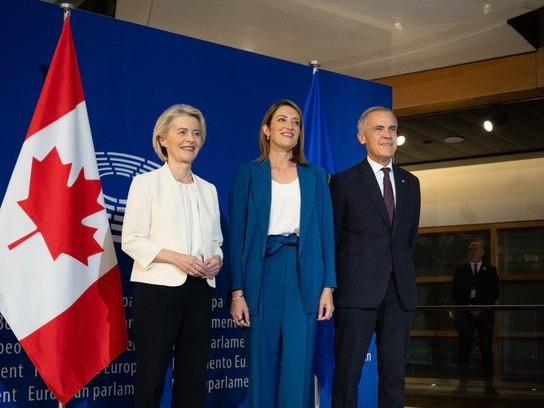
Yet this time, the setting added another layer of symbolism. Sitting in the European Parliament in Strasbourg was Canadian Prime Minister Mark Carney. In an unusually choreographed sequence, Carney returned to the same chamber the following day to address MEPs himself. Von der Leyen’s call was striking; she proposed to ‘open the door’ for Canada to become the European Union’s first associate member.
This was more than a diplomatic move. It was a signal that Brussels and Ottawa are considering whether their relationship can move beyond the established framework of partnership and free trade towards something genuinely new.
From CETA to an Alliance for the Future
They are not starting from scratch. Canada and the European Union have had a free trade agreement, known as CETA, in place since 2017. Between 2016 and 2025, trade in goods between the EU and Canada grew by roughly three-quarters, while trade in services nearly doubled. Most tariffs between Canada and the EU are already gone.
Removing tariffs, however, is not the same as fully opening markets, and both sides still shelter sectors they consider sensitive. Canada has retained its supply management system: chicken, turkey and eggs were excluded from the agreement altogether, while European dairy enters through limited quotas, with high tariffs above them. A 2025 Canadian law now prevents Ottawa from offering further access in future negotiations. On the European side, quotas cap Canadian beef and pork, while EU rules on hormone-treated beef and genetically modified crops restrict much of what Canadian producers can supply. The tariff work is therefore largely complete. The regulatory work is not, and that is precisely where a deeper partnership would have to operate.
Yet almost ten years after the agreement was signed, it still awaits full ratification in ten EU Member States, including France, Italy and Poland. There is a broader Canadian reality as well. Europe cannot replace Canada’s existing economic relationships overnight. Around three-quarters of Canadian exports still go to the United States, while geography makes diversification towards more distant markets a gradual process.
Nevertheless, that does not make the European opening less significant. It clarifies what it can and cannot achieve. For Canada, Europe should not be understood as a substitute for the United States or Asia. Rather, it is a complementary strategic partner: a wealthy and stable market, a source of investment and technology, and an increasingly important partner on defense, critical minerals, energy and economic security.
Indeed, the relationship has already moved beyond trade. Canada became the first non-EU country to participate in the EU’s new SAFE defense procurement framework, allowing Canadian entities and products to participate in relevant European procurement. Cooperation is also expanding across critical minerals, energy, artificial intelligence, advanced technologies and supply chains.
Von der Leyen framed the next stage as moving “from CETA to an Alliance for the Future”: a common prosperity and economic security space encompassing intelligent manufacturing, technology, defense industrial cooperation, the Arctic, energy, critical minerals and batteries, as well as AI, quantum technologies, cybersecurity and economic security. Most importantly, she stressed: “This is a partnership not against anyone else, but for our common strength.”
That distinction matters for Canada too. Diversification should not mean pushing away American capital or trade, but adding European, Asian and other sources of investment and opportunity alongside them. The objective is greater resilience, not the replacement of one dependency with another.
What Would ‘Associate Membership’ Actually Mean?
This is where the proposal becomes genuinely consequential. There is currently no established category of “associate membership” in the EU Treaties comparable to full membership. Article 49 TEU provides for accession by European states that meet the Union’s conditions. Canada falls outside that conventional accession framework. An associate relationship would therefore need to be defined as something fundamentally different: a new form of structured, highly integrated partnership with a country outside the conventional EU accession model.
This makes the political announcement only the beginning. The substance of any future arrangement would determine its significance. An associate member could potentially participate in selected EU programmes and policies, enjoy enhanced access to parts of the Single Market, and align with European rules in agreed areas. In return, the relationship would need to establish clear arrangements for regulatory alignment, institutional participation and the degree of influence Canada could exercise over rules to which it becomes closely associated. It would also need to sit coherently alongside existing EU trade, association and strategic partnership agreements.
There are considerations on the Canadian side too. The idea of associate membership has already generated debate about sovereignty and the extent to which deeper integration would entail accepting European rules in areas where Canadian regulation has traditionally been closely aligned with the United States.
These concerns should not be dismissed. They are precisely what a serious negotiation would need to address. The label itself matters less than the substance behind it. If pursued, associate membership could create an entirely new model of partnership between the EU and countries that share its values and strategic interests but are outside the conventional accession framework.
It could even become a prototype. Countries such as Australia, New Zealand, the United Kingdom, Norway and Iceland could eventually look at such a model, while countries in Europe’s wider neighborhood might consider whether a deeper relationship with the EU could offer an alternative between conventional partnership and full accession.
But that possibility makes the design of the Canadian model all the more important.
From Strasbourg to Montreal
Carney’s address to the European Parliament on 17 September provided a complementary Canadian perspective. His central message was simple: Canada and Europe are each strong, but they are stronger together. He presented the relationship not as the creation of a third bloc against another power, but as cooperation among partners that share values and want to strengthen their collective capacity to act.
His message echoed the argument he had made in his special address at the World Economic Forum in Davos 2026: in an increasingly fragmented international order, middle powers can work together to build resilience rather than simply submit to great-power rivalry.
The practical dimension of deeper integration will ultimately matter most to people and businesses. Mobility, education and research could become important components. Canada and the EU are already discussing participation in programmes including Erasmus+ and Horizon Europe. Closer cooperation could also facilitate professional mobility, research partnerships, digital trade and investment. These are the areas in which an ambitious relationship could move from diplomatic symbolism to tangible benefits.
Canada also has domestic work to do. Barriers between provinces, differences in licensing and procurement rules, infrastructure constraints and weak productivity limit Canada’s ability to benefit fully from new international opportunities. Greater European integration cannot solve those problems by itself. Nor can it replace the importance of Asian markets, particularly for Canadian energy, food, commodities and critical minerals.
This is not an argument against the European opening. Quite the opposite. A stronger Canadian economy at home would make Canada a stronger partner abroad; a deeper relationship with Europe would give Canadian businesses and institutions another major platform from which to grow.
The next test will be in Montreal. The EU-Canada Summit on 29–30 October will present the first major opportunity to translate the political momentum of Strasbourg into concrete discussions and, potentially, deliverables.
A Partnership for a New Era
The geopolitical context cannot be ignored. The proposal has already drawn criticism from Washington, including threats of retaliation. Yet both Brussels and Ottawa have been careful to frame the initiative as something built for their own resilience and common strength, rather than against another partner.
That may ultimately be the most important message emerging from Strasbourg. The EU-Canada relationship does not need to be defined by what it opposes. Its case rests on what the two sides can build together: resilience without isolation, strategic autonomy without autarky, and deeper integration without requiring political uniformity.
Europe cannot replace America’s economic importance to Canada, just as Canada cannot solve Europe’s strategic vulnerabilities. But neither side needs to choose only one partner. In a world of increasing geopolitical uncertainty, the ability to build several strong, trusted relationships is itself a form of strategic resilience.
Ambition is considerable. The institutional questions are even greater. Associate membership currently has no ready-made definition or treaty template. It will have to be negotiated, legally constructed and ultimately accepted through the EU’s institutional and national processes, while Canada will need to determine what level of integration it is prepared to embrace.
But the political significance of Strasbourg should not be underestimated. A European Commission President proposed a new relationship with Canada from the podium of the European Parliament, with the Canadian Prime Minister present. The following day, that Prime Minister stood before the same chamber and embraced the ambition of taking the relationship further.
It remains to be seen whether this momentum can be turned into substance and action.
For now, the door has been opened.
The next step is to decide what Europe and Canada will build behind it.