


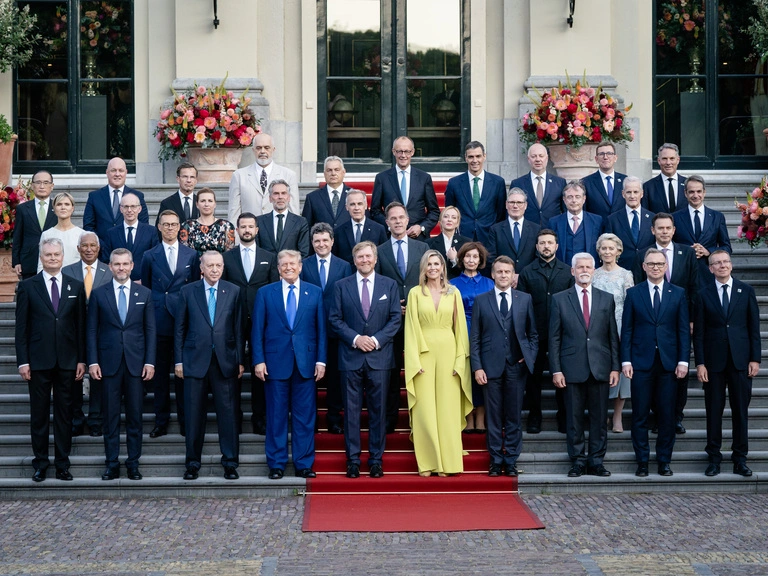
Everyone wanted to read and comment on the NATO communiqué. I sought out the conversations that would never appear in it.
As one of approximately 2,500 credentialed journalists covering this year’s NATO Summit in Ankara, I spent my days doing what summit reporters always do: waiting through security delays, sitting through press conferences, and trying to decipher what had changed between one carefully negotiated paragraph and the next. I twice attended Secretary General Mark Rutte’s predictable master of ceremony-like press briefings, waited two hours for President Donald J. Trump to address the media before giving up, fulfilling my commitment to TRT World, and watched the familiar choreography of diplomacy unfold beneath rows of NATO flags as I scurried about at the international media center. And yes, we were well fed.
The official story would soon be written.
But another summit was taking place just beyond the television cameras and select influencers posting passerby comments from heads of state.
It happened in breakfast discussions, roundtables, hallway conversations, and small gatherings where scholars, military officers, parliamentarians, and practitioners wrestled with questions that no communiqué could fully answer. Those were the conversations that stayed with me long after the barricaded roads reopened and the motorcades departed.
One discussion in particular left me unsettled.
At a side event roundtable on cognitive warfare and artificial intelligence, the mood was notably different from the optimism that often accompanies conversations about technological innovation. Rather than celebrating AI’s possibilities, participants grappled with an uncomfortable reality: the battlefield is moving beyond borders to how beliefs are formed and sustained. More democratically accountable societies are entering an era in which influence operations can be automated, synthetic audiences can be manufactured and trust itself is a strategic target.
The implications are impossible to ignore. The NATO conversation cannot remain simply about emerging technologies and defense spending targets. It must be about the changing nature of power associated with the mind and human cognition.
The most striking insight was not that artificial intelligence would make propaganda faster or cheaper. It was that future conflicts may increasingly seek to shape perception before they ever seek to seize territory. The contest begins long before land, sea, air, and space.
Amid all the concern about algorithms, synthetic media, and cognitive warfare, another theme quietly emerged. Democracies possess one strategic advantage that authoritarian systems cannot easily replicate. Credibility.
A note of caution is in order.
To describe NATO as a defender of democracy is more contested than many assume. The Alliance’s founding treaty of 1949 is unmistakably rooted in democracy, individual liberty, and the rule of law. Democratic governance, civilian control of the military, and political pluralism have long been central to its identity. Yet history, as it always does, complicates that public relations narrative.
Portugal joined NATO in 1949 under António Salazar’s authoritarian Estado Novo. Greece, a joiner in 1952, remained a member while governed by a military junta between 1967 and 1974. More recently, scholars have questioned NATO’s limited ability to respond when member states experience democratic backsliding, including pressures on judicial independence, media freedom, and the rule of law. The Alliance possesses formidable military instruments, but far fewer political mechanisms for safeguarding democratic practice within its own ranks. These tensions are hardly theoretical. NATO has long included members with differing democratic trajectories, reminding us that collective defense and democratic consolidation have never been perfectly synonymous. That distinction matters.
NATO’s primary mission has always been collective defense and not democracy promotion. Its success has been measured by deterrence, territorial security, and alliance cohesion. Yet protecting territory and protecting democracy are not always identical objectives.
Perhaps that is why the conversations I found most compelling in Ankara revolved less around military hardware than around trust, resilience, and credibility. If the next frontier of conflict is cognitive rather than kinetic, then the democratic character of societies becomes more than an abstract political ideal. It becomes part of their strategic resilience.
The question, then, is not simply whether NATO defends democracies. It is whether democracies can continue to defend themselves.
Democracies remain noisy, argumentative, and often painfully slow. Remember Churchill’s warning—no, not the Iron Curtain speech in Missouri in 1946, but the one about democracies:
Many forms of Government have been tried and will be tried in this world of sin and woe. No one pretends that democracy is perfect or all-wise. Indeed, it has been said that democracy is the worst form of Government except all those other forms that have been tried from time to time.
The greatest strength of democracies, likewise and defence of freedom alliances lies precisely in what makes them appear inefficient and muddlesome: transparency, accountability, open debate, and institutions capable of correcting themselves. As one participant observed, democracies undermine themselves when they attempt to imitate the methods of their adversaries instead of relying on the credibility that has always distinguished them.
That insight echoed something I have argued throughout my own career: the pursuit of truth remains a strategic asset. We all should be truth-seekers.
The CBS broadcast journalist, Edward R. Murrow, who rose to fame from the roof of the BBC with his “This is London” radio broadcasts during World War II, said fifteen years later as JFK’s director of the United States Information Agency, “truth is the best propaganda.” Today we might simply call it credibility. Who has it? Who doesn’t? Who has more, who has less?
Whether NATO is best understood as an alliance of democracies or primarily as a military alliance remained an open question until I encountered something less ambiguous. I met Iryna Nykorak.
She was a speaker in a small breakfast session of about fifteen women, with the theme, “Strengthening Readiness through a Whole-of-Society Approach” hosted by Women In International Security Italy (WIIS Italy). I could not believe my good fortune in being in a room full of bright women leaders as NATO pings masculine values. Although the discussion focused on a whole-of-society approach to security, its underlying message was profoundly human: military readiness begins with societal readiness. Security is not only about capabilities. It is about leadership, trust, civic participation, and the willingness of ordinary citizens to defend democratic institutions.
Iryna entered the room wearing a striking dress. I asked if I might photograph her. At first glance, it may seem an odd detail to remember from one of the world’s most important security summits. But as it turned out, she was wearing a Ukrainian woman designer’s dress.
Only later did I learn more about the woman behind the dress. A member of Ukraine’s parliament, author of Strong Women of the Strong Country, and founder of Arm Women Now, she spoke not as an analyst describing war but as someone living it every day.
The dress suddenly meant something much more to me. In a summit dominated by discussions of weapons systems, deterrence, and defense spending, it quietly asserted something that everyone can relate to. In different ways, we all become participants in the struggle for cultural survival. We defend our identity, our art, our music, our education, and ultimately our collective memory.
As she spoke to us about her everyday experiences in Kyiv, I felt that I knew better that nations of people fight for territory as much as they do for memory, preserving their language, and for the right to continue telling their own story. I knew that instinctively, but now I’m an eyewitness to it. I won’t soon forget it.
Authenticity is the most persuasive form of communication imaginable. Iryna embodied it. I have a face associated with women warriors in Ukraine who volunteer to fight so that the generations that follow them, whether their own children or not, can live their authentic selves.
If Iryna represented resilience, another remarkable Ukrainian scholar represented preparedness.
Dr. Halyna Padalko, a Ukrainian Fulbright scholar at MIT, is an emerging voice in cognitive security. She spoke on a roundtable, “Navigating the Mindfield: What Are We Missing on Cognitive Warfare, AI, and NATO’s Next Frontier?” sponsored by an organization with which I have affiliation, the NATO Strategic Communications Centre of Excellence based in Riga, Latvia.
Dr. Padalko belongs to a next generation thinking deeply about how democratic societies can defend themselves without sacrificing the very values they seek to protect. Her work reflects a profound understanding that information warfare is no longer merely about detecting falsehoods, as important as that is. It is about strengthening societies through education and advocacy so that manipulation becomes less effective in the first place.
Iryna represents a nation fighting for survival. The other, residing in Cambridge, Massachusetts, represents a generation preparing us for the kinetic-cognitive conflicts still to come.
They both live Ukraine’s story. Together they reminded me that NATO’s greatest strategic resource may not ultimately be its newest technologies or drone packages. It is the human front, the credibility of the people who defend democratic values every day and the storied experiences they share.
That is a lesson Ukraine has already learned through unimaginable sacrifice.
Perhaps the rest of us are only beginning to learn it.
The NATO Summit Communiqué was released on July 8, 2026.
Its paragraphs recorded alliance commitments, force posture, and strategic priorities, including multiyear commitments to Ukraine: “For 2026, Allies pledge €70 billion in military equipment, assistance and training for Ukraine and affirm their sovereigncommitments to sustaining at least equivalent levels in 2027.”
Long after I have forgotten the precise wording of those paragraphs, I suspect I will remember something else.
I will remember a Ukrainian parliamentarian whose quiet dignity communicated more powerfully than any slogan. I will remember a young Fulbright scholar helping democracies think through the next frontier of cognitive warfare.
And I will remember a realization that has stayed with me ever since Ankara:
AI may manufacture influence, but it cannot manufacture authenticity.
Democracies cannot algorithm their way to trust.
In the end, NATO’s most enduring strategic advantage may not lie in artificial intelligence or autonomous systems. For me, it lies in the credibility of free people everywhere.
Neither Iryna Nykorak nor Halyna Padalko appears in the official communiqué. Yet together they explained to me why it mattered.